Turnkey Construction of Reinforced Concrete Swimming Pools in Crimea
Building a concrete swimming pool on a turnkey basis means getting a ready-to-use pool with full design, construction, utilities, finishing, testing and commissioning delivered by a single contractor. In Crimea, with its mild coastal climate, picturesque locations and specific geotechnical and corrosion risks, a professional turnkey approach ensures durability, safety and long-term economy.
Why choose a reinforced concrete (cast-in-place) pool?
— *Durability:* Concrete shells, correctly designed and waterproofed, last for decades and can be renovated or reshaped.
— *Design freedom:* Any shape, depth and integrated features (beaches, steps, benches, infinity edges).
— *Load capacity:* Suitable for larger volumes, terraces, integrated equipment rooms, and commercial use.
— *Refinishing options:* Modern tiles, pebble, quartz or coating systems allow varied aesthetics.
Turnkey scope — what’s included
A full turnkey package typically covers:
— Site survey and geotechnical investigation
— Architectural and structural design, hydraulic and electrical schematics
— Permitting support and coordination with local authorities
— Earthworks, drainage and foundations
— Concrete shell construction, reinforcement and waterproofing
— Filtration, circulation, heating, disinfection and automation systems
— Finishing (tiles, plaster, pebble, deck), lighting and landscaping
— Commissioning, water balance, operator training and handover
— Warranty and post-delivery maintenance options
Typical construction stages and realistic timelines
1. Preliminary survey and design (1–3 weeks)
— Site visit, soil probe, concept drawings, estimate.
2. Permits and approvals (2–8 weeks, variable)
— Municipal approvals and utilities connections — time depends on local administration.
3. Excavation and site preparation (1–2 weeks)
— Shoring if needed; diversion of surface water.
4. Foundation and drainage (1 week)
— Gravel/compacted base, sub-drainage and sump pumps if high groundwater.
5. Reinforcement and formwork (1–2 weeks)
— Rebar placement according to structural design.
6. Concrete placement and curing (1–2 weeks)
— Monolithic shell pour(s) and controlled curing.
7. Waterproofing and secondary protection (1–2 weeks)
— Cementitious membranes, liquid-applied polyurea/PU, or welded PVC liners as specified.
8. Mechanical/electrical installation (2–3 weeks)
— Pumps, filters, heaters, heat pumps, chemical dosing, automation and lighting.
9. Finishing and decking (1–3 weeks)
— Tiles, plaster, coping, terraces and landscaping.
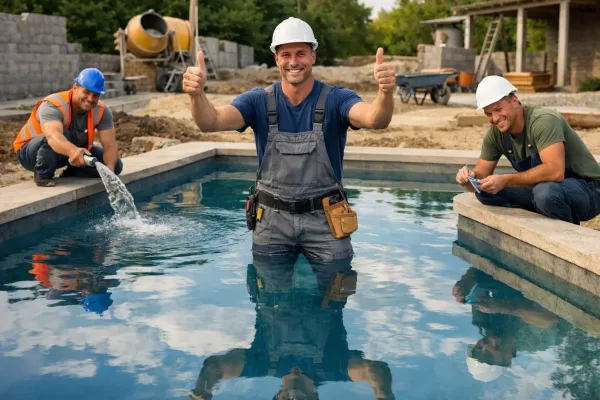
10. Commissioning and handover (1 week)
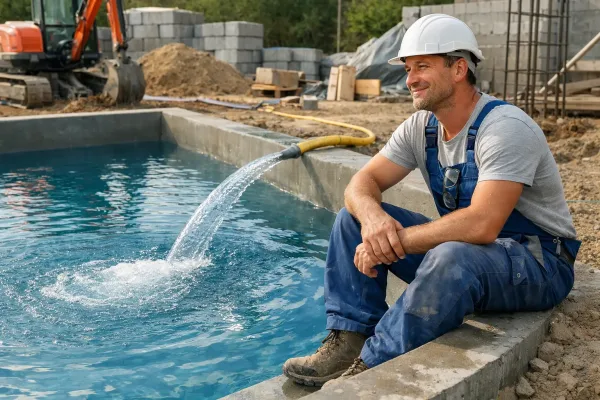
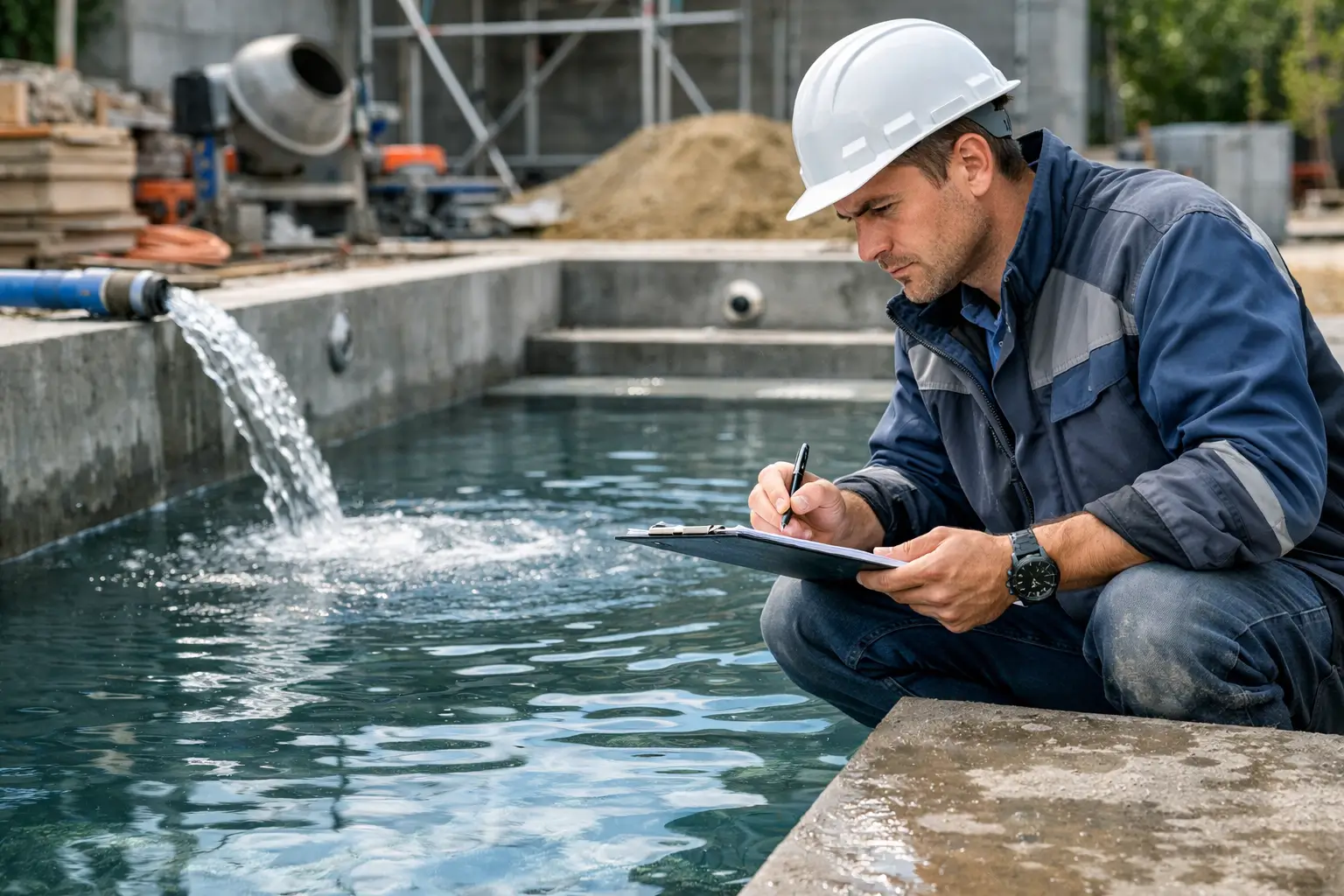
— Filling, leak test, filtration tuning, staff training.
Total: small residential pools — typically 6–12 weeks from groundwork to handover; larger or complex projects — 3–6 months or more, depending on approvals and complexity.
Local (Crimean) technical considerations
— Corrosion: Coastal salt air accelerates corrosion. Specify stainless steel AISI 316 for visible fittings and consider epoxy-coated or stainless reinforcement in critical areas.
— Groundwater and karst: Parts of Crimea have complex limestone and karst geology. A geotechnical survey is essential to avoid settlement, voids or unexpected drainage.
— Freeze-thaw: Although winters are mild in much of Crimea, some inland areas can experience freeze cycles. Use appropriate waterproofing, concrete mixes and insulation where needed.
— Water source and disposal: Coordinate with local utilities for water supply and wastewater discharge; in tourist areas water conservation systems (backwash recycling, efficient filtration) are recommended.
— Seismic design: In areas with seismic risk, structural design must comply with applicable standards for reinforced concrete shells.
Waterproofing and finishing options
— Cementitious waterproofing + tile finish — classic and durable for tiled interiors.
— Pebble/aggregate finishes — natural look, durable, slip-resistant.
— High-quality polymer coatings (polyurethane, polyurea) — seamless and abrasion-resistant.
— Reinforced PVC or liner systems — faster installation, suitable for some renovation projects.
Filtration, heating and automation
— Filtration: sand/DE/cartridge systems sized by turnover rate (usually 4–6 hours for private pools).
— Disinfection: chlorine automation, salt electrolysis (sanitiser), or combined systems with UV/Ozone.
— Heating: gas boilers, boilers + heat exchanger, electric heat pumps. Solar preheating can be effective in Crimea.
— Automation: remote control, scheduled backwash, dosing, safety interlocks and energy optimization.
Budget ranges and cost drivers (approximate)
Costs depend on size, complexity, finish level and site conditions. Approximate turnkey ranges:
— Small private pool (4×8 m) — from ~1.2–3.5 million ₽
— Medium private pool (6×12 m) — from ~2.5–6 million ₽
— High-end or complex private pools (heated, automated, infinity, landscaping) — 6–15+ million ₽
— Commercial pools (hotel, SPA) — start from several tens of millions ₽
Main cost drivers:
— Excavation difficulty, groundwater and rock removal
— Structural complexity and reinforcement
— Waterproofing and high-end finishes (tile, quartz, pebble)
— Mechanical equipment (heating systems, automation, UV/Ozone)
— Landscaping, decks, poolsides and auxiliary buildings
Maintenance and lifecycle
— Routine: weekly skimming, filter checks and backwash schedule, chemical balance checks.
— Monthly/quarterly: equipment inspection, heat exchanger servicing, pump bearings.
— Annual: full inspection of shell, regrouting tiles, service of heaters and control systems.
— Lifetime: a well-built concrete pool can last