Professional Turnkey Construction of Reinforced-Concrete Swimming Pools in Crimea
Building a reinforced-concrete (monolithic) swimming pool on a turnkey basis ensures durability, design freedom and long-term serviceability — especially important in Crimea, where coastal conditions, groundwater and local soils impose specific technical requirements. Below is a practical guide to the full-cycle process, key technical considerations for the Crimean environment, and the benefits of choosing a turnkey contractor.
Why choose a monolithic concrete pool (turnkey)?
— Exceptional durability and structural stability for decades.
— Unlimited shapes, depths and built-in features (steps, benches, overflow gutters).
— Improved resistance to ground movement when designed correctly.
— Single-contract delivery: project management, equipment supply, installation, commissioning and warranty.
Key local considerations for Crimea
— Coastal influence: increased chloride load and salt air accelerate corrosion — require corrosion-resistant reinforcement coatings and protective concrete mixes.
— Groundwater and capillary rise: many coastal plots have high groundwater; a thorough hydrogeological survey is needed.
— Soil variability: coastal sands, clays and limestone outcrops demand tailored foundation and retaining solutions.
— Climate: relatively mild Mediterranean climate but variable in highland zones — plan for winterizing in colder areas and consider solar heating efficiency.
— Regulatory compliance: design and construction should comply with applicable Russian standards (СНиП/СП/GOST) and local sanitary norms for pools.
Turnkey construction stages (what to expect)
1. Preliminary consultation and site audit
— Site visit, topographic survey, soil and groundwater investigation (geotechnical and hydrogeological report).
— Assessment of access, utilities (water, electricity, sewage), slope and landscaping constraints.
2. Concept design and feasibility
— Pool geometry, depth profiles, technical room layout, equipment list (filtration, heating, chemical dosing).
— Preliminary estimate and project timetable.
3. Working design and approvals
— Structural drawings, reinforcement schematics, plumbing and electrical plans.
— Preparation of documents for municipal approvals and sanitary requirements (coordination with local authorities when needed).
4. Excavation and base preparation
— Controlled excavation and dewatering if necessary.
— Sub-base (lean concrete or compacted bedding), drainage layers and waterproofing pre-treatments.
5. Reinforcement and formwork
— Anti-corrosion measures for rebar (epoxy-coated, stainless reinforcement where required).
— High-quality, precisely installed formwork for the designed shapes.
6. Concrete pouring and curing
— Concrete mix designed for exposure class (chloride, sulfate resistance) and required strength.
— Controlled placement, vibration, and extended curing to avoid cracking.
7. Primary waterproofing and protection
— Cementitious waterproofing membranes, crystalline additives, or polymer-modified systems.
— External drainage and protective screeds to protect the shell from groundwater and root action.
8. Plumbing, systems installation and technical room
— Installation of drains, skimmers, return inlets, overflow channels, piping with corrosion-resistant materials.
— Mounting of filtration, pumps, heaters (heat pump, gas boiler, solar integration), UV/ozone or advanced oxidation systems, chemical dosing and automation.
9. Finishing
— Interior finishes: ceramic mosaic, tiles, quartz plaster or specialized pool coatings (polyurethane/epoxy).
— Decking, coping, ladders, lighting (underwater LED), and safety features.
— Landscaping and external works as part of turnkey scope.
10. Commissioning, balancing and handover
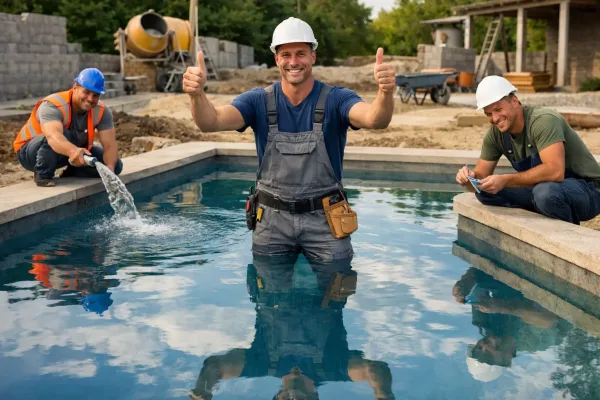
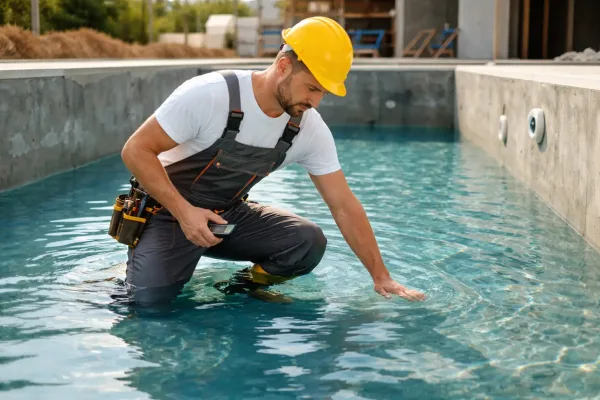
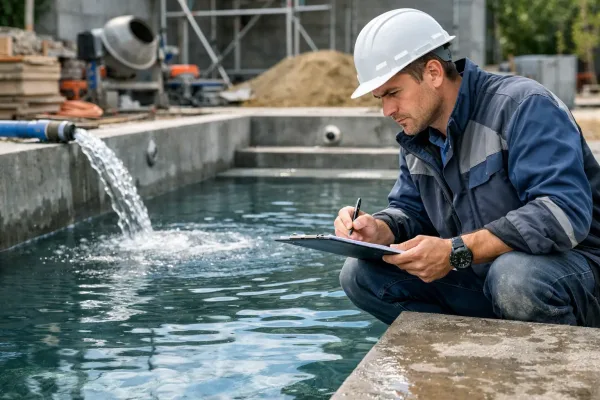
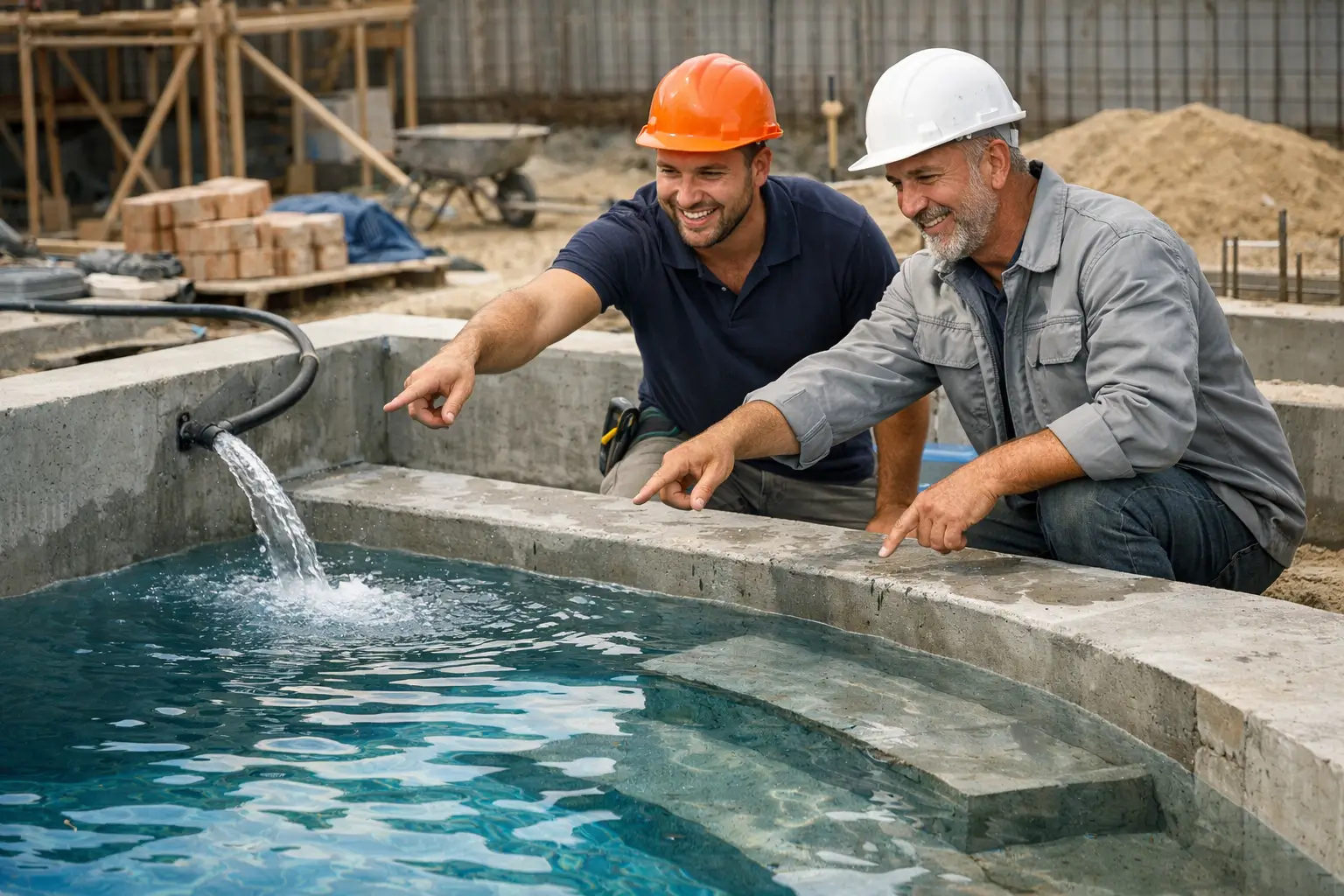
— Filling, system flushing, chemical balance, performance testing and operator training.
— Final inspection, documentation and warranty activation.
Technical recommendations for Crimean conditions
— Use concrete with low permeability and sulfate/chloride-resistant cement. Consider crystalline waterproofing admixtures.
— Apply corrosion protection for reinforcement: epoxy-coated rebar or coatings for the concrete shell.
— Design for hydrostatic uplift: include tension anchors, bottom slab thickness and drainage relief systems if groundwater is high.
— Install an external perimeter drainage system and waterproof membrane on the outside of the shell.
— Choose finishes and equipment rated for marine environments (salt air resistant).
— Consider automatic chemical dosing and remote monitoring to reduce manual maintenance and ensure consistent water quality.
Water treatment and equipment options
— Filtration: sand filters, glass-media or high-end cartridge systems depending on flow and footprint.
— Disinfection: chlorine systems, salt electrolysis (saltwater pools), UV and ozonation as supplementary disinfection.
— Heating: heat pumps (efficient in Crimea’s mild climate), gas boilers, solar collectors or combined systems.
— Automation: pH/ORP controllers, dosing pumps, scheduled filtration cycles, and remote alerts.
Typical timelines
— Small private pools (simple geometry): 6–12 weeks from excavation to handover (site-dependent).
— Medium pools with technical complexity: 3–4 months.
— Large or complex projects (landscape integration, basements, special finishes): 4–6+ months.
Timelines vary with permitting, ground conditions and custom design complexity.
Cost drivers (what affects price)
— Pool size and complexity (shapes, depth changes, built-in features).
— Geotechnical conditions and required dewatering/retaining works.
— Quality of finishes and equipment (premium filters, automation, heating solutions).
— Access and