Professional Turnkey Construction of Reinforced Concrete Swimming Pools in Crimea
Building a concrete swimming pool on a turnkey basis means you get a single contractor responsible for everything — design, permits, site preparation, construction, equipment installation, finishing, commissioning and handover. In Crimea’s unique coastal and inland environments this approach delivers higher quality, clearer accountability and better long-term performance.
Why choose a reinforced concrete pool?
— *Durability and longevity*: properly designed and built concrete pools last decades and allow structural repairs and renovations.
— *Design freedom*: any shape, depth and integration (beaches, infinity edges, steps, benches).
— *High-end finishes*: ceramic tile, glass mosaic, polished plaster or durable polymer coatings.
— *Repairability*: structural or finish works are straightforward compared with prefabricated shells.
Turnkey construction process — step by step
1. Preliminary consultation and site inspection
— Review site access, utility connections, topography and client goals.
— Recommend initial layout and construction method (cast-in-place, shotcrete/gunite).
2. Design and engineering
— Architectural pool plan, structural calculations, hydraulic and filtration schematic.
— Reinforcement and concrete grade specification, waterproofing strategy.
3. Geotechnical survey and permits
— Boreholes/soil tests to determine groundwater, bearing capacity and frost depth.
— Prepare and submit local permits; check coastal zone and drainage regulations.
4. Earthworks and foundation
— Excavation, soil stabilization, sub-base preparation and drainage provision.
— Temporary shoring if needed.
5. Reinforcement and formwork
— Installation of rebar cage per engineering drawings; corrosion protection where required.
— Formwork for walls, benches and ledges.
6. Concrete placement and curing
— High-quality concrete (specified grade) placed and vibrated; appropriate admixtures used.
— Controlled curing to avoid thermal cracking.
7. Waterproofing and secondary structural protection
— Internal crystalline or cementitious systems, barrier membranes, or composite waterproofing depending on finish.
— Corrosion protection for embedded metal (epoxy-coated or stainless steel).
8. Mechanical and hydraulic systems
— Filtration, circulation pumps (preferably variable-speed), heating, chemical dosing, automation, and drains/overflow systems.
— Selection of materials resistant to salt air if near the sea (316 stainless, special coatings).
9. Finishes and tiling
— Tile/mosaic setting with flexible/washed grout, or application of plaster/polymer coatings.
— Edge coping, non-slip zones and integrated safety features.
10. Backfill, deck and landscaping
— Proper backfilling and compaction; terraces, paving, fencing and landscape works.
11. Commissioning and water chemistry balancing
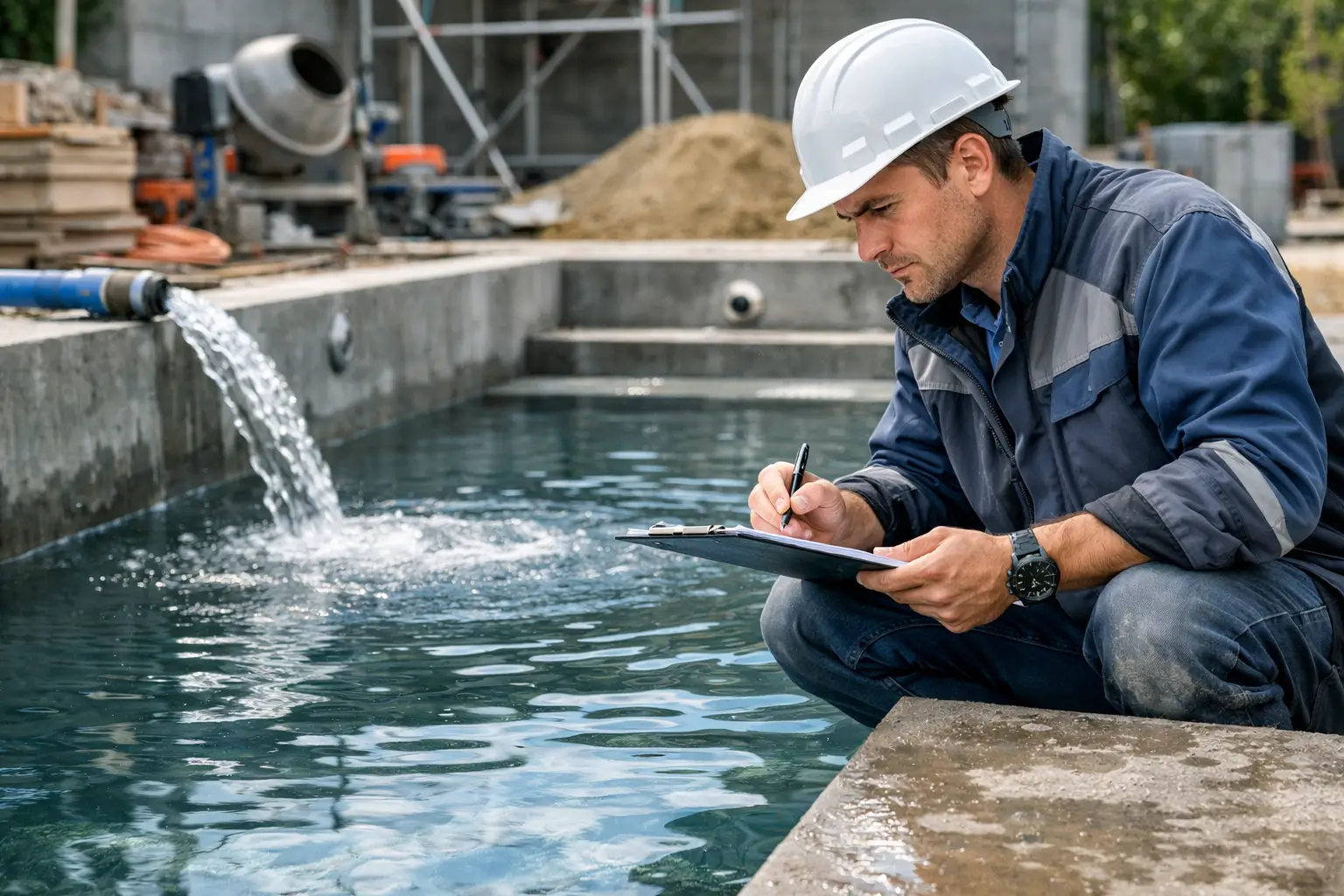
— System flushing, leak testing, filtration calibration and first fill with chemical balancing.
12. Handover and training
— Delivery of documentation, maintenance schedule and operator training.
Key technical considerations for Crimea
— Soil and groundwater: many coastal areas have high groundwater or clay soils — thorough geotechnical investigation is essential.
— Salt air and coastal exposure: use corrosion-resistant metals (AISI 316), polymer piping and specially formulated coatings to avoid premature corrosion.
— Freeze–thaw and thermal cycles: include adequate insulation (XPS, thermal breaks) and frost-resistant finishes where required.
— Water table and drainage: design for hydrostatic pressure relief (relief drains, filtration trenches) to prevent heaving.
— Local regulations: verify municipal building approvals, shoreline setback rules, wastewater discharge and waste management requirements.
Equipment and systems — recommendations
— Pumps: variable-speed for energy efficiency and quiet operation.
— Filtration: sand or cartridge systems sized for full turnover time (typically 4–8 hours depending on use).
— Disinfection: automated dosing (chlorine or alternative systems like UV/ozonation) and pH control.
— Heating: heat pumps, gas boilers or solar thermal—select per budget, efficiency goals and climate.
— Automation: remote monitoring, chemical dosing control, and scheduled backwash cycles simplify operation.
— Covers: automatic or manual covers reduce heat loss and evaporation, important for energy savings and maintenance.
Quality control and testing
— Concrete testing (slump, cube/cylinder samples) and documented curing regime.
— Pressure and leak tests for hydraulic circuits.
— Commissioning checklist: flow rates, turnover, heater performance, chemical automation accuracy.
— Final walk-through and rectification list before handover.
Maintenance essentials after handover
— Weekly: test and adjust chlorine, pH, alkalinity; skimming and filter checks.
— Monthly: backwash filters, clean skimmer baskets, inspect seals and equipment.
— Seasonally: heating system service, winterization if unused, inspect for cracks and coating degradation.
— Annual: professional inspection of structure, waterproofing and mechanical systems.
Choosing a contractor in Crimea — questions to ask
— Do you provide a turnkey contract with a clear scope, milestones and price?
— Can you supply local references and examples of completed concrete pools?
— Are you licensed for excavation, structural works and pool system installations?
— What warranties do you provide for structure, waterproofing and equipment?
— How will you address coastal corrosion and groundwater issues specific to the site?
Typical timeline and cost drivers
— Typical project duration: from 8–16 weeks for a standard private pool (site-specific factors can extend this).
— Major cost drivers: pool size/complexity, geotechnical mitigation, waterproofing system, mechanical equipment quality, finishing materials and landscaping.
Final notes
Turnkey construction of reinforced concrete pools gives owners a single point of responsibility and the ability to achieve complex, long-lasting designs suited to Crimea’s varied coastal and inland settings. Prioritize experienced engineering, corrosion protection, robust waterproofing and clear contractual terms to ensure a successful, low-maintenance pool that performs for decades.
If you’d like, I can outline a sample project timeline for your specific plot in Crimea or provide a checklist for evaluating local contractors.