Professional Turnkey Construction of Concrete Swimming Pools in Crimea
This article describes the full cycle of designing and building reinforced concrete swimming pools on a turnkey basis in Crimea, with practical guidance on technical decisions, local considerations, legal and environmental issues, timelines, typical costs and maintenance.
Why choose a concrete pool (advantages for Crimea)
— Durability and longevity — properly built concrete pools can last decades and accept repairs and remodels.
— Design flexibility — any shape, depth, steps, benches, tanning ledges, infinity edges or integrated spas.
— Suitability for local conditions — can be engineered for sites with slopes, high groundwater or special finishes (natural stone, tile).
— Repairability — cracks and finishes can be restored more easily than fiberglass shells.
Regional considerations in Crimea
— Climate: Hot summers and relatively mild winters — heating and covers reduce seasonal energy use; winterization still required in cold spells.
— Geology: Limestone, karst zones and variable soils are common. High risk of voids/sinkholes in some areas — geotechnical survey is essential.
— Groundwater: Coastal and valley sites can have a high water table — requires careful waterproofing, drainage and possible dewatering during construction.
— Environment and zoning: Coastal protection zones, protected areas and heritage sites in Crimea may impose restrictions or require additional approvals.
— Materials and logistics: Use local suppliers for aggregates, sand, tiles and stone where possible to reduce cost and delivery time.
Turnkey construction: typical scope (what “turnkey” includes)
— Preliminary consultation and site visit
— Concept design and 2D/3D visualization
— Geotechnical survey and engineering foundation calculations
— Working drawings and specification of materials/equipment
— Obtaining required permits / coordination with local authorities (if required)
— Earthworks, excavation and site preparation
— Structure construction (reinforced concrete shell: formwork, rebar, shotcrete/gunite or cast-in-place)
— Waterproofing, insulation and drainage
— Plumbing, filtration, heating and automation systems
— Interior finishes (tile, plaster, stone) and pool edge coping
— Commissioning, water balancing and handover
— Warranty, maintenance training and after-sales service
Step-by-step process and technical highlights
1. Preliminary design and budget
— Define size, depth, shape, intended use, finishes and equipment (heating, salt/chlorine systems, lighting).
— Initial budgeting and options comparison (heated vs. unheated, cover types).
2. Site survey and geotechnical investigation
— Boreholes to determine soil type, bearing capacity, groundwater level and detect karst.
— Engineering recommendations for foundation type and anti-floating measures.
3. Permitting and approvals
— Check municipal requirements for capital construction, wastewater discharge, and coastal protection.
— Prepare necessary documentation; contractor should advise and support submission.
4. Excavation and base preparation
— Proper benching and temporary shoring if needed.
— Sub-base with compacted crushed stone and sand; provision for drainage and subsoil waterproofing.
5. Structure: reinforcement and concrete
— Reinforced concrete shell: cast-in-place, sprayed concrete (gunite/shotcrete) or precast panels.
— Correct rebar layout, shrinkage joints and control joints per structural design.
— Anti-buoyancy measures (anchors or concrete slab) when groundwater is high.
6. Waterproofing and insulation
— Multiple layers: cementitious waterproofing + flexible polyurethane coating, or bonded PVC membranes.
— Thermal insulation (XPS) under and around shell where heating is planned to reduce heat loss.
— External drainage (perimeter drains) to relieve hydrostatic pressure.
7. Plumbing, filtration and technical room
— Proper sizing of circulation pumps, hydraulic layout, skimmers, drains and overflow systems (prefabricated gutters or weir).
— Filtration: sand, cartridge or diatomaceous earth depending on capacity and clarity goals.
— Disinfection: chlorine dosing systems or salt electrolysis; consider automation and dosing controllers.
— Heating options: gas boiler, electric heater, heat pump (most energy-efficient), solar pre-heating.
— Automation and remote control for pumps, heaters, lighting and chemical dosing.
8. Finishes and waterproof testing
— Interior finishes: ceramic mosaic tile, large-format tile, polished plaster, quartz plaster or natural stone.
— Expansion joints at coping and interfaces.
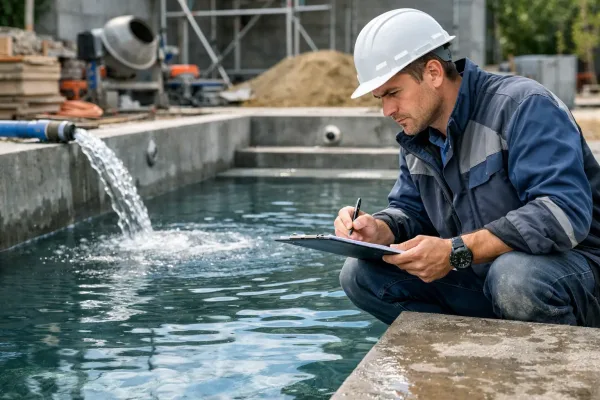
— Hydrostatic testing and commissioning with leak detection prior to filling with final water treatment.
9. Handover, documentation and warranty
— Provide as-built drawings, system manuals, maintenance schedule and warranty documentation.