Professional Turnkey Construction of Concrete Swimming Pools in Crimea
Building a concrete swimming pool on a turnkey basis delivers durability, design freedom, and a single point of responsibility from concept to handover. For property owners in Crimea, local climate, coastal conditions and soil characteristics add specific requirements that experienced contractors must address. This article explains the turnkey process, key construction stages, material choices, local considerations, timelines, cost drivers, and what to look for when hiring a contractor.
Why choose a monolithic concrete pool on a turnkey basis?
— Durability and longevity — properly designed and constructed concrete pools can last many decades.
— Unlimited shapes and custom features — steps, benches, infinity edges, tanning ledges, integrated spas.
— Single-responsibility delivery — design, permits, construction, commissioning and handover by one contractor simplifies coordination and accountability.
— Better integration with site infrastructure — mechanical rooms, landscaping, automation systems and pool surrounds installed as part of the package.
Local considerations for Crimea
— Coastal exposure: sea air increases chloride-induced corrosion risk for reinforcing steel. Corrosion protection and high-quality waterproofing are essential.
— Groundwater and soil: varied soils (rocky areas, loess, alluvial zones) require geotechnical assessment to determine excavations, drainage and hydrostatic relief solutions.
— Seasonal temperature range: proper thermal design and freeze/thaw-resistant finishes are necessary in the northern and higher-elevation areas.
— Permits and regulations: local municipal requirements, construction permits and utility connections must be clarified in advance.
— Logistics and materials: choose suppliers and admixtures familiar with the region and resistant to local environmental conditions.
Turnkey process — step-by-step
1. Initial consultation and briefing
— Site visit, discussion of goals, preferred shape, finishes and budget range.
2. Feasibility and preliminary design
— Concept sketches, preliminary cost estimate, basic engineering check (site slope, access).
3. Geotechnical survey (recommended)
— Boreholes or test pits to assess soil, groundwater level and bearing capacity.
4. Final design and engineering
— Structural drawings, hydraulic calculations for filtration/heating, electrical and plumbing schematics.
5. Permitting and approvals
— Preparation and submission of required documents to local authorities; coordinate utility approvals.
6. Site preparation and excavation
— Clearing, temporary fencing, excavation to design depth, dewatering if necessary.
7. Foundation, reinforcement and formwork
— Installation of prepared sub-base, rebar cages, formwork. Corrosion-protective measures for rebar (epoxy-coated rebar or adequate concrete cover).
8. Concrete placement
— Cast-in-place concrete shell or shotcrete application; appropriate concrete mix with admixtures for impermeability and shrinkage control.
9. Curing and structural inspections
— Proper curing period to reach specified strength; non-destructive testing if required.
10. Waterproofing and finish layers
— Cementitious or membrane waterproofing, installation of tile/mosaic, polished plaster, or other chosen finish.
11. Mechanical, hydraulic and electrical installations
— Pumps, filters, heaters, automation systems, dosing equipment, piping and skimmers installed and pressure-tested.
12. Backfilling, decking and landscaping
— Backfill with suitable material, construct surround surfaces, terraces and integrate landscaping.
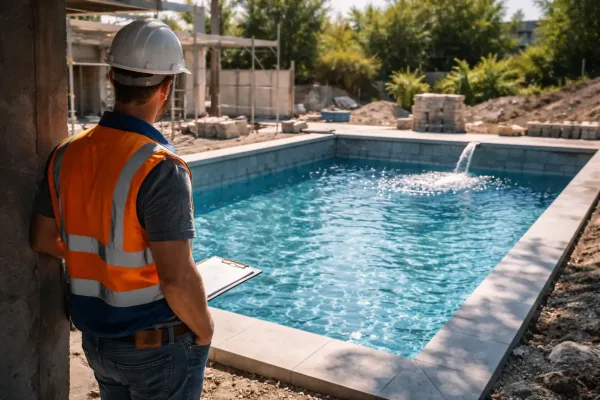
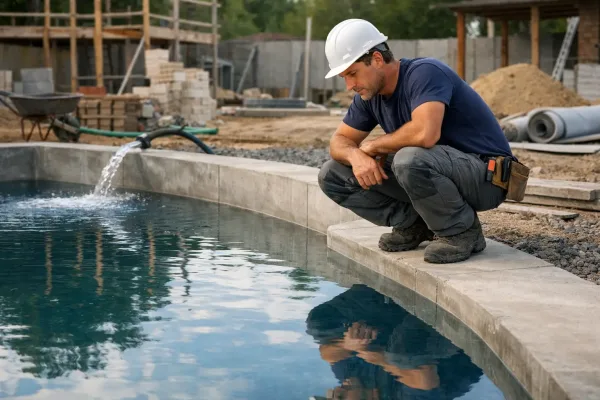
13. Commissioning and water balancing
— Fill, disinfect, test water chemistry, adjust filtration/automation settings, demonstration and handover.
14. Handover and warranty
— Provide operation manual, maintenance schedule, and warranty documentation.
Materials and technologies to prioritize
— Reinforced concrete (monolithic) with adequate cover and corrosion protection for reinforcement.
— Waterproofing: multi-layer systems — cementitious coatings, flexible membranes or liquid-applied membranes approved for pools.
— Filtration: quality sand, cartridge or DE filtration sized to turnover rate (usually 4–8 hours depending on use).
— Water treatment: automated dosing and UV or ozone options for reduced chemical consumption.
— Heating and insulation: heat pumps, gas boilers or solar preheating; thermal insulation under shell where needed to reduce heat loss.
— Automation and safety: level sensors, chemical controllers, remote monitoring, anti-entrapment drain covers and fencing/alarms as required.
Typical timeline and cost drivers
— Typical turnkey timeline: 3–6 months from final design to commissioning; may extend depending on permits, site conditions and complexity.
— Main cost drivers:
— Pool size, depth and complexity of geometry
— Finishes (mosaic, natural stone, high-end plaster)
— Site access, rock excavation or dewatering needs
— Corrosion protection and waterproofing systems
— Mechanical equipment quality and automation
— Landscaping, terraces, and additional amenities (lighting, heating)
— Local labor and material availability
Environmental, safety and operational considerations
— Manage stormwater, sediment control and proper disposal of excavation material.
— Ensure electrical installations comply with safety standards for pools and have RCD/GFCI protection.
— Provide hydrostatic relief valves or drainage in high groundwater areas to prevent flotation.
— Plan for noise and dust mitigation during construction in residential areas.
— Offer a maintenance contract or owner training for ongoing water chemistry and equipment care.
How to choose a turnkey contractor
— Ask for a portfolio of completed pools in Crimea or similar coastal locations.
— Verify engineering credentials, licenses and insurance.
— Request references and visit completed projects if possible.
— Ensure a clear written contract: scope, milestones, payment schedule, warranty terms and post-handover support.
— Confirm use of corrosion protection, waterproofing guarantees and commissioning procedures.
— Look for a contractor who offers a detailed technical proposal rather than a rough estimate.
Common warranty and post-construction items
— Structural warranty on the shell (varies by contractor).
— Warranty on mechanical equipment (pumps, heaters, filters) per manufacturer terms.
— Waterproofing and finish warranty — conditions and exclusions should be clearly stated.
— Offer training for pool operation, winterization (if applicable), and a first-year follow-up.
Conclusion
A professionally built concrete pool on a turnkey basis provides reliability, tailored design and simplified project management — particularly important in Crimea, where coastal exposure and variable soils require experienced local execution. Prioritize a contractor who performs geotechnical investigation, uses corrosion-resistant detailing and proven waterproofing systems, and offers clear documentation and warranty. Proper planning and a turnkey approach will deliver a durable, low-maintenance pool that enhances your property and provides long-term enjoyment.
For next steps: arrange a site visit with a reputable turnkey contractor to get a preliminary design and tailored estimate.